Tuesday, January 26, 2016

Bonneyville Mill

Back in the old days.......and I mean before the age of the automobile, tractors and the like, if you were a farmer and needed to get any of your grain processed, you had to somehow "tote" it to a grist mill somewhere.  Some of the old timers would do exactly that.  They would hitch up a team of horses to their wooden wagon and haul the grain to get it ground into flour or livestock feed. In later days farmers would bring their grains to the mill with the wagons hitched to their newly found tractors.

I am very fortunate to live near one of these old mills that is still in operation today as an attraction and is on the National Register of Historic Places.  This mill is called Bonneyville Mill and is located in Elkhart County, Indiana just east of the little town of Bristol.  The mill is right in the heart of the 223 acre Bonneyville Mill County Park and is open from May through October every year.

Each fall, usually in September, the Bonneyville Mill County Park hosts an event called "Bonneyville Heritage Day" where there are a lot of things going on to bring attention to Elkhart County's rich agricultural heritage. Antique tractor and machinery exhibits abound as well as sawmill demonstrations and, of course, the grinding of corn, wheat, rye and buckwheat which can purchased. You can learn the history behind this old mill here. [http://www.elkhartcountyparks.org/properties_locations/bonneyville_mill.htm]
Very interesting history indeed.

Here are a couple of photos that I took of this old mill in 2011.  I think it's a beautiful structure!


Anytime you are in this part of the country and you're inclined to find your mind wandering back to the "good ol' days", it would be well worth your time to look up this gorgeous site.

Friday, January 15, 2016

What The Heck Do You Do With Your Restored Old Iron?

Answer is....I don't know there is a perfect, absolute answer to this question.  The main reason is that there are too many people that collects an old piece of iron (or two or three) or restores them and they may all have different ideas.  Display 'em, use them on their hobby farms, invest in them, whatever!  But one thing is for sure, there are a lot of these people who attend antique tractor shows with their machines solely for the purpose of the parade.  You get to drive 'em, right?

Aaaah.....the parade!  Back in the early fall of 2014, I had visited the 32nd annual Antique Engine and Tractor Show held by The Michigan Flywheelers on the grounds of their Museum.  Their Antique Engine and Tractor Show is one of the state of Michigan's largest shows of its kind.  And of course, when it came time for the parade that day, I decided to get me a good spot about the middle of the parade route, and prepared my trusty Canon EOS digital camera.

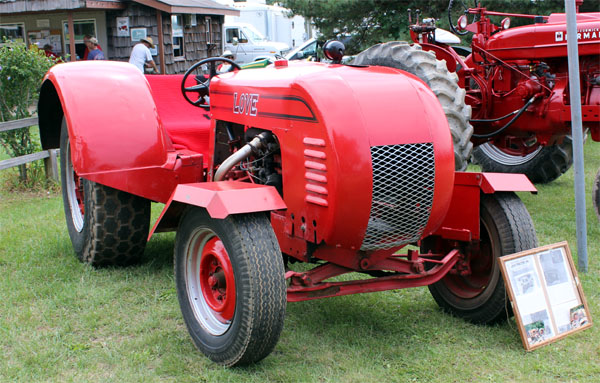
There were hundreds of old tractors in this show and there were at least 50 of them entered in the parade.  There were lots of the more common tractors built by International Harvester, John Deere, Case, Allis Chalmers, Minneapolis Moline, etc. but also some of the more rare manufacturers, too.  One of these "rare" tractors was the "Love" tractor like the 1939 model shown here during the parade that day.  The Love tractor company was located in Benton Harbor, Michigan in the early days and later relocated to Eau Claire. Michigan.

The company was founded by Jabez Love of Benton Harbor, Michigan soon after he got out of college.  Living around the "fruit belt" of Southwest lower Michigan, he saw the need for the fruit farmers in the area to get their produce to market faster.  He decided to build a vehicle from car and truck parts that would not only be sturdy, but would have a better top speed than the tractors that were being built in that time and day.  

Jabaz build row crop tractors in the early years beginning in 1933.  They were not popular in the area for fruit farmers though and the production didn't last very long before Jabaz was only producing the wide front orchard type tractors.  These were made between the years 1933 and 1936 and could reach 40 mph.  Really?  That was amazing for this time period.  Well, in this part of the country, a lot of the land was used to produce apples, peaches, grapes and other fruits and his wide front orchard tractor was the best application for operation in orchards and vineyards.  

These tractors were made all the way through 1937 when Jabaz began to redesign his orchard tractors with a new style hood that became famous for its look.... like the one shown in these photos.  These newly designed tractors could still work in fields plowing, discing, etc but could also reach 60 mph on the road.  This road speed was a step above most other tractors being built at the time.  The Model 30 had a 218 Cubic Inch Chrysler Industrial six cylinder engine (like the one shown in this post) and proved to be a real work horse.
As I said before, there were a lot of other tractors in the parade that day, but this one really caught my eye and I thought that I'd kind of let some other folks know a little bit of history about these old beasts.  Some of you viewers may already know the history of the these tractors and the Love company, but for those of you who don't.......Enjoy!

Thursday, January 14, 2016

The History of Farming Must Guide Our Future

A farmer’s love for the earth and its seasons permeates his whole outlook. We may love the heavy farm equipment and modern tractors that make the work go faster – we need to stop and think (and learn) if we are doing what is best for the healthy regeneration of the planet. Examining some of the slower farming methods of the past can give us insights into how to best move forward into our collective future. The time to revert to some of these methods, for the sake of our health, and the health of the soils and the natural environment, is upon us.


Wangari Maathai, Nobel Laureate and soil activist, explains: “We take the soil for granted because it’s there; it’s everywhere, except when all of it is taken by the wind or by the running water. And then you are left with bare rock, and you realize you can’t do much with bare rock.”
In the pre-industrial age farming was a much different profession, in fact, most families who had some land would grow the majority of their own food – working together to plant, weed, tend, grow, harvest, prepare, and store food they had grown themselves from season to season. Animal-powered plows and hand sowing was common.
Seed saving was common as well because it also made the most sense: save the best seeds from your most prolific and hearty growers from year to year and you have healthier, more disease resistant, larger, tastier, crops every planting season. These became what we now call heirloom varieties – varieties that were selectively bred for favorable characteristics over time by the farmers who knew and observed their yields. If they picked the early or late germinators, they could even change the timing of their cops to avoid other seasonal issues, like frost, heavy rain, or recurring pests.

Unfortunately, we now also have GMO seeds, and seeds that are genetically designed to produce sterile fruits – making it harder and harder for farmers to eke out a living or scrape together the funds needed to buy seeds year after year. These seeds also do away with hand selection of robust plants, leaving little for the observant farmer to do but tend their growth and then do it all again the next year with virtually identical seeds – with no attempts to change in yields or productivity.
Community seed libraries are sprouting (pun intended) up around the nation, and growing our own food, saving the seeds, and swapping our seeds and surpluses with our friends, family and neighbors has become a revolutionary act.

Additionally, low tech solutions to farming are, while slower, much healthier for the soil and all the microorganisms that live therein. In a handful of soil there are hundreds of millions of organisms including bacteria, fungi, nematodes, insects, and others. Most of them work together symbiotically, essentially acting like the stomachs of the roots and creating a perfect environment for the transfer and uptake of nutrients from the surrounding soil – to the plants that grow in it. All of these microorganisms work together, to allow for not only the transfer of nutrients and the best conduction of water across membranes as well. 
In a commercially or mechanically farmed and tilled property – the soil unfortunately becomes compacted over time. The act of tilling and the pressure of the wheels, and the exposing lower parts of the soil or breaking through tough compacted layers may provide a temporary solution of opening up the ground in order to plant a seed. Unfortunately, these practices do nothing to create a rich healthy soil in the long-term - leading to unresolved and unhealed scarring year after year. This leads to cumulative unfavorable conditions like nutrient or water runoff issues, soil erosion, blow off, and more.

The easiest, healthiest soil is made from the breakdown of bio matter over time becoming a mixture of composted plant matter, bacteria, and fungi. This rich topsoil can include leaves, branches, twigs, grass, dead animals, manure, and other natural breakdowns over time that refuel the soil and create soft, sponge-like topsoil. If you’ve ever been in a protected old-growth forest, you’ll know what I’m talking about – the ground feels springy beneath your feet when you walk and the moisture held in those layers is apparent – especially in early mornings when the fog covers the forest floor.


It’s time to have heart-to-heart conversations with our soils, as Paul Gautschi does in his conversations with God in the Documentary Back to Eden, and ask the earth what it needs to heal and regenerate – before we lose our ability to grow healthy foods entirely. As Miguel Altieri, professor of Agroecology at the University of California explains in the documentary, Dirt! The Movie, “If we don’t take care of the soil, which is just the first five centimeters of life that is on the earth, our future is totally condemned.”

(NOTE:) 
This article was written by Christine Rudolph [christinerudolph91@gmail.com] and sent to us for reposting here on our blog.  Thanks Christine!


Wednesday, November 7, 2012

Are you kidding me....Wooden farm Equipment models?


Here's something that might interest some of you Farm equipment and hit & miss engine guys and gals. Last year I met a guy through some e-mail conversations from my other web site called Ol' Dave's Woodshop. His name is Tom McAllister. Tom has been making wooden models for over 20 years now and in my humble opinion has developed a skill that few people ever try to accomplish. His work is immaculate in that the detail is not only apparent, but extremely attractive as well. Here is a link to an article I posted last year to my Antique Tractor web site called "Fastrac" where Tom had built a model of a 1958 Oliver 770 Diesel tractor.

Tom has recently retired and is now spending his time remodeling his house and building these fantastic models full time. I recently received another e-mail from him informing me that he was currently involved in repairing a 1930 Case hay press (baler) at his club and got so intrigued with it that he decided to try to build a wooden model of one of these old hay balers. He said he didn't have a clue as how to make the gears for it but after some trial and error, (and he said "heavy on the error") that he finally figured it out. The model, he says, works just like the real one. He said having a real full sized baler to go by made it much easier than his usual method of using what pictures that he could find or take on his own.
 

Take a look at the two photos (below) of Tom's finished model of this old baler.


He told me that since the actual real piece of equipment was orange, he decided to use African Mahogany for the body and American Hickory for the gears, wheels and hay shoot.

The guys at his club also challenged him to make a wooden hit and miss engine to run the model baler..... and so he did. This hit and miss engine model has a little battery-operated motor in it. He told me that he needs to work out a way to get more power to the engine and that he needs to find or make a drive belt, but as you can see from this short video below, he's well on his way. It even sounds a little like the real thing.


The engine is supposed to look like a McCormick-Dearing 6 or 8 hp. Take a look at the two photos of his hit & miss engine below.... I think he came pretty dang close, don't you? Most folks wouldn't know a hit and miss engine from a toaster but some of you would and I think he got about as close as most of us would ever get in an attempt like this. Tom's reason for choosing the model that he did is that this model of engine was one of the easiest styles to hide a motor and batteries in (which is necessary to make it run). It runs on 3 volts (or at least 3 volts gives the speed he wanted to achieve). Tom said that the two AAA batteries just don't have much staying power but he might try to solve that problem down the road.


Anyway, Tom has a web site called "Woodman's Collectibles" which you might want to go visit if this kind of thing is of an interest to you. I find it fascinating!

Sunday, January 1, 2012

Wow...What a Truck!

Last fall I had the pleasure of attending the Bonneville Mill Fall Festival in Bristol, Indiana whereas there were quite a few old tractors, antiques, old time farming demonstrations and the like. One of the first things that I came upon while walking down to view the old tractors was a sawmill demonstration. I had been to this festival several times in past years and this sawmill demonstration was always powered by old steam engines.

This year was much different in that the power source for the saw equipment was an old home built power truck being operated by Todd Bush. The truck is a 1934 Ford which was originally a dump truck. It was amazing to me that this old truck had enough power to run the portable sawmill. The power obviously didn't come from the engine under the hood, it came from two 85 HP Ford flathead V-8 engines and transmissions attached to two Ford truck rear axles. All of this was mounted on the flatbed of the truck. the photo above right shows a close-up of the setup on the back of the truck.

When the unit is hooked up to the pulleys on the sawmill, it all looks like that in this photo here on the left.... the truck serving power to the mill (this photo not really a good one....sorry about the quality)

From talking to Todd, I was able to obtain a little more history on the truck. Here is some of what I was given........

It seems that in the old days of threshing, steam engine power was the only power strong enough to run the separators (threshing machines) but they were huge pieces of equipment that had to move from one farm to another. When farm tractors were eventually developed they took they place of the steam engines as a power source. In both cases however, moving from one farm to another was a long process at 2 - 3 miles per hour.  Getting the proper amount of power to machines in a much quicker time frame was the primary reasoning for this truck's existance!


The original developer of the 34 Ford power truck shown here was developed by Lamoin Bush and his son Max back in 1940 or so and they began using it for threshing in 1941. The truck was purchased from the Indiana State highway department and, as mentioned above, was originally a dump truck.  Lamoin had been using it to haul gravel, ice and other things until deciding to convert it to be used as a power unit for threshing.

The right hand engine has a Pierce governor belted to the crankshaft, which controls the speed on both of the engines. The gear train on this unit is two ring and pinion units for power input and a belt pulley on one of the wheels. Each engine has its own starter, clutch and cooling system (although only one generator is actively working at a time). The belt pulley was made from a Ford truck wheel and blocks of hardwood which eventually drives the belt.

After lining up the belt with the saw equipment, the right engine, which has the governor attached, is started up first. Once it is running, then the other engine is started. With both transmissions in high gear, the clutches are engaged (both clutches are engaged at the same time via a single clutch lever). The throttle operates this way as well.....that being a single control which was made from an emergency brake lever.  A 55 gallon oil drum is used to hold the fuel needed.

There is a lot more history and detail about this old truck in an article written by Pat Ertel that appeared in "This Old Truck Magazine" (which is now called "Vintage Truck Magazine") back in November, 2001. You might try to find that article on their website for those of you who might be interested.

It sure was a pleasure to meet Todd,  a grandson to Lamoin (who passed away in 1976) and to watch this old truck in action. This family exhibits the truck at many shows around the Midwest and if you ever get to see it operating, it will most likely amaze you..... as it did me.

Enjoy!

Monday, August 1, 2011

Swamp Sisters

One of the neatest little places I've found this year!

While visiting my brother at his summer home in northern Minnesota, he suggested that we go to breakfast at a quaint little place near his home near Brookston, MN. About ten miles from his home, deep in the north woods, a group of sisters (I think there are about 5 of them) opened up a restaurant that is only open on the weekends.

Their family operates a farm carved out of the woods where they raise buffalos and process the meat. They serve the meat at the restaurant (as well as selling it individually to customers) and boy was it good! If you didn't know where this place was you would have a hard time finding it.

They don't do any advertising (as far as I know) and the customers hear about it by word of mouth.  As we arrived, you can see an old Minneapolis Moline tractor sitting in the front of the restuarant and being used as an attraction for the customers. I don't know for sure what model of MM tractor it is....but it don't really matter!  You can see a picture of it here above and to the right (The restaurant is in the background in the photo).

I must say, this was a real treat to an old tractor buff! I just had to share this with you all. The breakfast was delicious........especially the buffalo sausages that I had with my eggs. Northern Minnesota is beautiful any time of the year..... particularly in the summer. For those of you who have never been in this part of the country, the area is famous for its mining of iron ore and is very rocky terrain in most spots. The entire north shore of Lake Superior near this area which is close to Duluth is extremely beautiful to see.

The area is a world famous area to find and collect "Lake Superior Agates" which we have found ourselves obsessed with. If fact, my nephew who also lives in Duluth, is a professional photographer specializing in north country landscape and gemstone photos. If you want to see some of these beautiful specimens of agates and other gemstones, you can see them on his website here.

This area is an awesome area of our country to behold. I would suggest that if you ever want to visit a place that is as beautiful as any place in the U.S. then plan yourself a trip to this western end of Lake Superior. The area is full of history of the mining and shipping industries in America.

Enjoy!

Wednesday, January 5, 2011

Preserving The Past!

Last fall a friend of mine traveled to Kansas for a short vacation to visit his wife's cousin whom they had not seen for a long time. As you probably know all too well, Kansas has a rich history in prairie farming. Aahhh.....those were the days! That's what a lot of the antique tractor collecting hobby is all about. Remembering the old days on the farm!

Soon after the turn of the 20th century, farmers were transitioning from horse drawn equipment into motorized power usage. There were many companies forming to manufacture replacement power for these pieces of equipment and one of the most prominent companies was the John Deere Plow Company. After developing the steel plow through many years of changes (and improvements to their plows) they began buying noncompeting farm equipment companies and started moving toward becoming a major player in farm equipment.

One of the companies that was purchased was the Waterloo Gasoline Traction Engine Company located in Waterloo, Iowa. They had introduced the "Waterloo Boy" tractor to farmers and out of this grew the development of a more powerful tractor with a lower center of gravity that was to become one of the most popular tractors available in the early part of the 20th century. That tractor was the John Deere Model "D".

This is where I get back to the story of my friend's trip to Kansas. Little did he know that his wife's cousin had restored one of these early John Deere D's! He sent me a picture of that old tractor that was taken at a fall festival that they all had attended on that trip. The tractor was mounted on full steel wheels. Here is the picture...........


You can see in the background a much newer John Deere four wheel drive tractor that is the result of the John Deere company's continued development of farm equipment. This old "D" restoration is very typical of what is taking place around the country in the last three or four decades within our hobby...... preserving some of these old beasts for the younger ones to see in the future!

I think this is a great photo of an extremely well restored piece of history and for all to see in generations to come......Don't you think?

Tuesday, November 16, 2010

Birthplace of Harry Ferguson

Hey Ya'll......

We received an e-mail a few weeks back from Trevor Mitchell who lives in Northern Ireland, the birthplace of Harry Ferguson. Trevor sent us a few pictures of the birthplace site which you can see here in this post. I thought that this was very interesting, especially if you are interested in the history of old tractors and in particular the Ferguson tractor.

As you may or may not know, Harry Ferguson was very instrumental in the development of the early tractor and some of the innovations that made these early tractors more efficient and useful.

Trevor lives in Bangor, in Co Down along the shores of Belfast Lough about 30 miles away from Harry's birthplace. You can see a cool looking flower popping Ferguson in the memorial garden directly across the road from Harry's birthplace in the townland of Growell outside Hillsborough in County Down. (South West of Belfast just south of the M1 motorway). Here's a picture of it!


The garden was opened on 21st Aug 2008 and that day his granddaughter Sally Flemming, who had traveled from London, unveiled the life size bronze statue of Harry seen in the picture below.

Note he is carrying in his hand the Ferguson spanner. When the statue and gate were brought together it was discovered the top bar of the gate was the same height as his eyes, so to avoid this, they had him stand on a stone so you could see his face over the top gate bar.

Each year they have a big celebration at the field beside the house when tractors from all around attend. Here are some of the old Fergusons (among others) that were line up at a recent event in the field.

Harry was known not only for tractors and their development, but for a racing car as well. And, he was also the very first person in Ireland to build and pilot his own plane.  The house where Harry was born can be see in the photo here below.

We want to give thanks to Trevor for sharing this all with us and to Ulster-Scot.com for allowing us to use the pictures that Trevor sent to us and provided provided by them.

Enjoy the photos!

Thursday, October 7, 2010

A Great Time For Antique Tractoring!

Up here in the Indiana north with the leaves turning to their beautiful reds, yellow and orange colors, it gets your personal motor running fast if you're an antique tractor fanatic like me! The cooler air, not as much humidity and the crackling of leaves as you drive your pride and joy over them. Geez, what more could you want? You may or may not get to see these color changes in the south (depending on where you live) but it still gets cooler in the south, doesn't it?

I don't live in the south and don't get much of a chance to be down there in the fall, but I regularly hear from folks who do.  They welcome the changes in seasons just the same.

Fall is one of my favorite times to go tractoring. Shows and events are saved for this special time of the year for a lot of clubs and organizations and it just seems right! The air gets a little heavier and the smoke from the tractors and old hit & miss engines just hangs in the air at these events. A great time to enjoy the sights, activities and food that you find there.

Even without the fall festivals, fall is an absolute great time to take an extended drive into the country if you're so blessed to be still able to do that. It's harvest time on most farms and seeing this in real time is good therapy for the soul! Just looking out over the fields, ripe with their bounty, makes you reflect upon the good ol' USA and the freedom to even do this. Even so, you sometimes get a glimpse of an older tractor or piece of equipment still being used in today's world!

Fall leads to winter though, so if you find yourself anywhere near the snow belt, enjoy these milder, cooler days while you still can. Preferably on or around an old tractor somewhere.

Monday, August 23, 2010

The Farmall Dynasty

Last fall, I received and e-mail from Lee Klancher, a friend whom I had met through my regular Antique Tractor Website called "Fastrac." He invited me to review one of his most recently released books entitled "The Farmall Dynasty." Lee mailed me a signed copy of the book (for which I am deeply thankful) so that I could review it. Since I am an avid Antique Tractor enthusiast, I began reading the book. I immediately recognized that, if you were a collector, restorer of International Harvester or Farmall tractors and/or equipment, that this book could be an invaluable addition to your library.

I completed the read shortly after receiving the book but had never actually reported on the experience of what I had found in those pages. My thoughts today are that I had never lived up to my side of the promise I had made to Lee. I had never written a review! My entry today in the blog is a belated attempt to fulfill that promise to him.


The book is loaded with photographs of IH and Farmall tractors and equipment covering the history of the International Harvester company from it's beginning to the present day. While reading though the pages, it became readily apparent to me that there had to have been an extraordinary amount of research conducted  putting this book together. "The Farmall Dynasty" is loaded with Farmall information.

In the book, Lee details the sequences in which different IH tractor models were produced, including dates and production numbers. He also reveals to the reader most of the "whys" behind the introduction of most of these models. I found that there were many things that I did not know and I am a fairly well read antique tractor fanatic!

The book is an absolute "must have" if you are a Farmall nut! You can find out more about the book by visiting Lee's website here.   Lee..........thanks for your books (the one that you gave to me and the ones that all Farmall fans should own!)

Dave

Wednesday, August 18, 2010

Lookin' For Old Iron

If you're an avid fan of antique tractoring, you have probably at one time or another in your old tractor admiring days, scouted the fence rows or other places for potential restoration projects. I know I have many, many times. My brother and I had even adopted a hunting scheme for doing this. You can read about that story, complete with a description of that scheme, on my regular old tractor website here.

It just so happens that some of this old equipment is getting more scarce by the day. Here's a picture of an old hand crank Case on full lugged steel that is just begging for someone's attention.

No one knows for sure whether this old beast has enough of it left to salvage, but it sure would be an awesome sight if it could get someone to restore it back to its original condition.

There are still enough of these old carcasses around to be found! In fact, just about 10 miles south and west from where I live is an old tractor boneyard that covers over 60 acres of this old stuff. I'm not going to reveal the exact name and location of this place in this article because the last known owner of the place is kind of protective of it, but if anyone is near Northern Indiana, let me know and I'll clue you in privately!

It just breaks my heart that a tremendous amout of this old stuff is getting cut up for scrap iron on all too frequent of an occasion. Bottom line is, if you ever get a chance to find an old piece of iron like that in this picture and you have the desire and resources to acquire something like it.......Just Do It! It'll make you extremely happy and you'll have saved a piece of history

Wednesday, August 4, 2010

Summer Tractor Show Bonanzas

Antique tractor fans are everywhere! There are literally hundreds of antique tractor shows and events all across the country and in Canada at all times of the year. But especially in the summer time. For the most part, summer is the best time in the Northern part of North America because it can get pretty chilly in the fall and in some parts of the north country, nearly impossible for outside events in the winter.

A good friend of mine sent me some photos of an event (Georgian Bay Steam Show ) that was held in Cookstown, Ontario, Canada on July 30 through August 2, 2010. The show featured Allis Chalmers tractors and equipment. The show grounds covers 20 acres and there were daily demonstrations of a sawmill, shingle mill, horse drawn wagon rides and a parade of equipment. You can see in the attached photo, some of the machines that were lined up at this particular event.

These kinds of activities are almost always present at any of a number of shows of this type. People attending these shows are simply having great fun and sharing stories, collecting new information and just generally diving in to the realm of antique tractoring. Some of the neatest people I have met over the years have come from acquaintences I have made at these shows.

If you have never been around one of these shows, you should try to find one in your area this summer and take the plunge! It's a great way to learn more about the history of farming and agriculture from days gone by.   Don't know where to find a show near you?  Go to my regular Antique Tractor website called FASTRAC and click on "Events" from the main menu and you should be able to find one!
 
It's great summertime fun to say the least.

Thursday, July 22, 2010

Rare Tractor, Indeed!

There are a lot of old tractors that are considered rare for various reasons. Some of the reasons are quite apparent and others are not! A lot goes into that determination such as low production numbers, early year of manufacture, how tractors might have been set up during production, experimental models, etc.

I found one of these rare tractors at the 2010 Red Power Roundup event a few weeks ago that is actually quite rare but you wouldn't immediately know it. It's a 1954 Farmall Super M-TA Hi-Clearance tractor with a single front wheel and set up to use propane fuel. (See photo below).


Any one of the above features in and of themselves would not necessarily make a tractor rare.  So then, what makes this particular tractor rare besides the obvious fact that it is a Hi-Clearance tractor with a single front wheel running on propane? 

One thing is that the Super M-TA, (regardless of how they might have been set up from the factory), were only produced in any configuration for one year......1954.  These tractors were built as transition model tractors and had some innovative additions that led to the hundred series...... tractors that were ultimately more prevalent.

The Super M-TA was the first Farmall tractor built with torque Amplification (TA) which was a high - low range transmission equipped to allow shifting "on the fly". Engaging the TA feature reduced the speed of the tractor by about 1/3 giving the driver more pulling power to work with. An operator could more closely match the power output to the load. This was quite an innovation during this time period.

These tractors also had an independent PTO (Power Take-Off). Without going into detail, which was fairly complexed to achieve, power was transferred directly to the rear of the tractor bypassing the clutch. The rear of the tractor of course is the most convenient place to find power to operate other equipment.

There were only 23,523 Super M-TA's or Super MD-TA's (Diesel models) made in all configurations and one set up like this particular tractor are hard to find! Quite a nice restoration don't you think?

Sunday, June 27, 2010

Pink Getting Popular!

Last fall I made a post on this blog about a courageous lady who was fighting breast cancer and as a result, her husband painted his 1957 John Deere Pink during its restoration to help in the cause for cancer awareness.

Well.........Its catching on! This past Saturday I attended the 2010 Red Power Roundup Antique tractor event in LaPorte, Indiana. I never have seen so many red tractors in one place in my life. My brother and I walked around the many acres of red IH tractors viewing them and admiring their owners pride in displaying them. There were tons of different models and variations of models being displayed throughout the event.

There was a huge amount of IH Cub cadets at the show too, displaying mostly yellow, white and blue paint schemes on them. We could also see an abundance of the later model red cub cadet lawn & garden tractors on display at the show.

And, of course, there were quite a few of the earlier model IH's such as the popular Farmall F-12's. F-14's, 10-20's and Farmall Regulars.....all sporting their typical dark gray paint schemes.

And then, continuing our exploration around the exhibit grounds, we ran into this.............

A pink IH Farmall Super M!

Unusual...........You bet! (The paint, not the cause!)

It brought my thoughts back to the lady and her husband's pink John Deere last fall (posted on this blog back on 9/14/09). Not only was this Super M tractor in very excellent shape, the paint was applied flawlessly! What struck me most was the willingness of an antique tractor owner to deviate from the authentic paint scheme of the original model of his Farmall Super M, but the possible forfeit of the tractor's value from having done so. But folks, it's NOT about the tractor, it's about the fight for a cure of one the most dreadful and feared diseases on our planet!  That's what I admired most.....the sacrifice of this owner for a great cause!

I never did get to meet the owner of this tractor however, after standing around it for quite some time at the show. But I am reasonably sure that the pink paint symbolizing the cause for a cure touched a whole lot more people than just me!

I just wanted to share this with you all.........I thought it was cool!

Thursday, April 8, 2010

Tractors or Antique Tractors?

Which is it? You know, this question always depends upon who you are and what you have. My dad used to tell me that anything over 25 years old is an antique. I don't know if I ever believed that or I would have to consider that even I am an antique.

On the other hand, some believe that when an item (such as an old tractor) has served its current day usefulness that the item would be considered old enough to be considered an antique. When a tractor fits in to this category, just a literal ton of people like to bring them back to life by restoring them. I love that! I believe however, that an old tractor is more closely considered an antique when it is nearing the 50 year old mark. Whether people restore these old pieces of machinery at 25 years old or nearer 50 years old, the love of doing it is where the rubber meets the road so to speak.

Clifford Ernst is just a perfect example of one of those folks. He has a fairly rare old tractor that he has restored back to life. It's a 1919 Moline Universal Tractor and not only is it very old, it is unusual in it's design (see photo).


Could you imagine finding parts for an old beast like this? Most likely there would be parts that would have to be specially made by hand or under contract to someone who could remanufacture the needed part. I don't know if that was the case for any part on Clifford's tractor or not, but you must agreee, he has done a beautiful job on this restoration.

In my book, this is a perfect example of an antique tractor.......... Old, unusual and beautifully restored to original condition. Well done!

Wednesday, November 18, 2009

Time To Get 'Em Winterized!

I know...... you all don't really like to think about getting ready for winter (at least those of you that live in the cold parts of our nation). But, if you don't want busted radiators or engine blocks in your restored tractor, this is a must do! You need to make sure that the old tractor radiator and engine is full of good ol' antifreeze! I know it's not entirely the same, but I forgot to drain the main trunk of my in-ground sprinkling system last winter and paid the price in the spring with a broken main feed line to the system. Not quite the same as a radiator or engine block but busted just the same!

It's easy to forget or even procrastinate to the point of forgetting to invoke the proper maintenance going into winter and it'll cost you plenty if you do. There are a tremendous amount of old antique tractor collectors that do not have the luxury of a heated storage building and they need to take the necessary precautions.

Having said that, I envy those of you who have the warmer climates in some of the southern states and can still get out and run your equipment. Up here in northern Indiana, it is very hard to have fun outside on your old tractor. I mean you still can, but it for sure is not as comfortable!

If you are one of the lucky ones that does live in the south and you have an event that you can go to, I'd like to know some more details about that event. I'll get in posted on Fastrac, my antique tractor information support group website. Just leave a comment with the info here on the blog and I'll get it put on the events pages of the site. You can also e-mail me the details at: dave@adeptr.com

I'm getting ready to settle in for the winter and I'll get my fill of antique tractoring this winter by working with the website and this blog. When spring rolls around, I'll be tired of writing and be more than ready to start heading out to the shows again up here in the north.

Good thing I have developed patience over the years......the older I get, the longer the winters seem to be getting. The winter will be tolerable however, if I can end up in the spring with no holes in the block.

Hummmm .... We'll see!

Monday, September 14, 2009

Pink John Deere?

After retrieving the local newspaper from the mail box this morning, the first thing I noticed on the bottom of the front page was an article headline: "Pink tractor pulls hope for a cure." Number one, being an avid antique tractor fan, the word "tractor" in the headline caught my eye. And number two, I noticed the picture that accompanied the article was not a modern day tractor!

Turns out that a local antique tractor collector was in the process of restoring his 1957 John Deere 520 when he and his wife discovered that she had been told by her doctors the breast cancer she had been fighting since 2005 had advanced into her liver. After receiving this news, this tractor collector decided to paint the tractor pink to help in the awareness of this dreadful disease and finding a cure.

I thought this was awesome!

The couple plans to show the tractor at several of the local (northern Indiana) tractor shows and/or festivals. One of these events is near the couple's home. The event: The Nappannee Apple Festival in Nappannee Indiana to be held next weekend, September 17 - 20, 2009.

The finished tractor will also be on display at the "American Countryside Farmers Market" on the last weekend of September.

I was impressed by the humor still maintained by this couragious lady while fighting this battle. She said of the tractor, despite the one-of-a-kind paint job it pocesses, "It doesn't sound pink!"

If your are in or around Elkhart County, Indiana this weekend or throughout the end of the month, you might want to try to get an on-sight look at the tractor in person. And, if you can't, try to do everything that you can to help support those who are trying to find a cure for breast cancer..... just as this couple are doing!

Tuesday, July 21, 2009

Think Fall!

You usually get a good feeling, when you are dead in the middle of the summer, about what lies ahead with your interests in antique tractors. Why is that? For me, it's the anticipation of the fall events. Shows and stuff are fun to attend while it's hot but are especially exciting for me with the cooler weather in the fall.

What I like about the fall events is that the air is heavier and when you wake up at one of these events (assuming you are camping out at the show) is the smoke from the tractors and old engines. It seems to just hang in the air over the show grounds and creates a haze for almost as far as you can see. This is special! Maybe not too good on the old lungs but the smell and the sight is wonderful for the tractor enthusiast's soul.

You ever wonder what it would be like to have been a farmer back in the day when you had to get up early to do the chores and all you had for power was that team of Belgians? Not much smoke from them! (Not much power either in comparison to your beloved tractors). They got the job done however, but it took a lot longer too. Thank God for progress.

Most of the days for a one or two small tractor farm is pretty much gone now too. But that's why we have these shows in the first place....... to remember what was! I sure do and I'm not really that old. There is a place at these shows for the younger ones too. Even though they may not be old enough to have seen any of the old machinery in action, at these events they get a chance to see it all and most importantly, learn about what it was and how it was used.

Guess what? You have six or seven weeks to get your old piece of iron all fixed up and shiny. Why don't you plan to take it to one of the fall events in your area......you'll be glad you did!

Wednesday, May 20, 2009

Spring Once Again!

Well, Well. Here it is ..... spring once again! It really feels good here in Northern Indiana to finally be getting some decent warm weather. This past winter was a grueling one in this part of the country. I personally have not had too much activity centered around the old tractor thing since the shows that were present (and that I attended) last fall.

The winter months found a lot of collectors and enthusiasts getting time to work on their collections or to begin a restoration process that summer months did not afford a lot of extra time to do. I'm sure there was a lot that got accomplished over the winter. But now, there will be a host of other thing to do with the coming months being warmer (at least that is the case up here in the North).

I know that around here,there are more than just a few of the clubs that are having swap meets and plow day events to keep the juices flowing. One such event just passed at Doud's Orchard Plowday on May 2, 2009 in Denver, Indiana. My understanding is that they had a really good turnout.

If you know of a good event that is going to be occuring in your neighborhood this spring, let me know and I'll get it posted on Fastrac (my antique tractor website). We have a really good listing of events there. Until then, have a really good spring and most of all, have fun with them old tractors!

Dave

Friday, April 24, 2009

Well….. How's this for news?

I haven't had a post yet in '09 but I really am NOT dead yet! I have had a lot to do since the first of the year. I just recently retired from the day job and have been extremely busy training the new guy that took over my position during the first part of the year.

Finally done! My last day was March 27th and I have finally seen some daylight to the odds and end jobs that I had been putting off. Now I can spend more time with this blog and my two websites: http://www.adeptr.com (the antique tractor site) and http://www.oldaveswoodshop.com (the woodworking website).

Old tractors have been a passion of mine since childhood and Fastrac, the antique tractor site, is an endeavor that I undertook back in 1996 to share some old tractor stuff with other people. It has reached a pretty good audience since that initial launch back in '96 and the plans are to move forward with more stuff related to the hobby.

The other website (Ol' Dave's Woodshop) is a relative new site launched at the end of the summer last year (2008) and is a result of a newly found interest in woodworking. I have been assembling quite a few pieces of equipment in my shop over the last six years in anticipation of my retirement. I didn't want to head into retirement without something to take up some of my time. This new hobby and my continuing fascination with the old tractors should prevent any kind of stagnation of my time.

If you want to see what I have been up to with either of these two websites, feel free to click the links and I would be interested in any comments that you may have related to them.

Until the next time…… Keep on tractoring!!

Dave